
Swiss control power markets
As the Swiss transmission system operator, one of Swissgrid’s responsibilities is to procure frequency control products to ensure the balance between electricity generation and consumption. The energy systems and balancing markets in Switzerland and Europe have undergone rapid change and development. The strong growth in electricity generation from photovoltaics (PV), the increase in flexibility potential enabled by new technologies, regulatory developments and advances in digitalisation, create new challenges and opportunities for Swissgrid in ensuring grid stability.
In the Balancing Roadmap Swissgrid presents the planned developments for the balancing markets and other factors that influence frequency control. Due to the delay in concluding an electricity agreement with the EU and Swissgrid’s continued exclusion from the European balancing platforms, Swissgrid is focusing on shaping the Swiss balancing markets while continuing to pursue existing international collaborations.
How do the balancing markets work?
Electricity cannot be stored in the transmission grid, so the amount of electricity produced must always match the amount consumed to keep the system in balance. Swissgrid is responsible for maintaining this balance in Switzerland and therefore for guaranteeing secure and stable grid operation at a constant frequency of 50 Hertz (Hz). If the frequency deviates too far from 50 Hz, this can damage electrical systems and devices or, in extreme cases, lead to the automatic shutdowns of power plants and consumers, or even to widespread power outages.
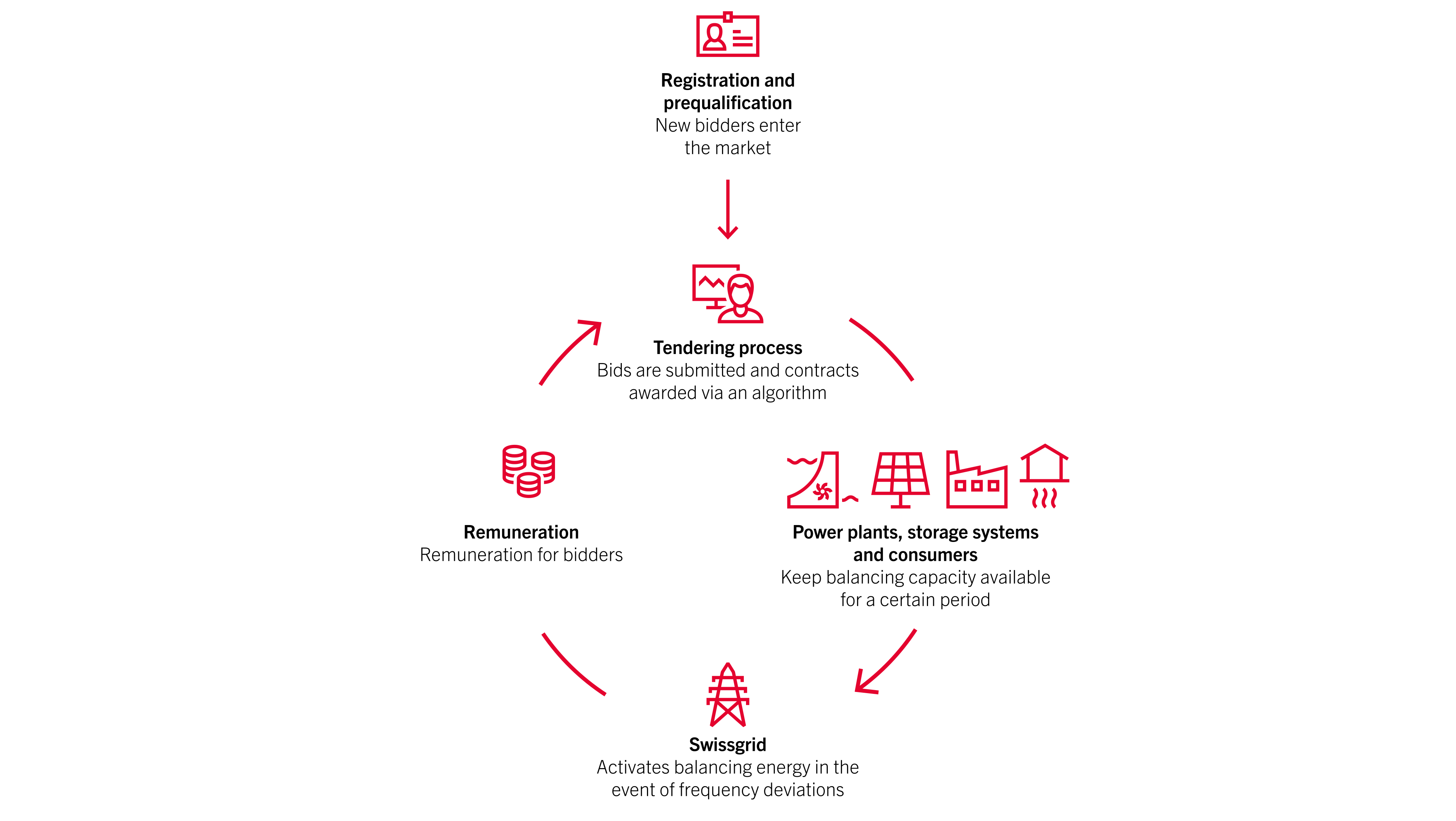
In the event of imbalances in the grid, Swissgrid utilises balancing energy and instructs power plants, storage systems or consumers to increase or decrease their generation or consumption. However, Swissgrid does not own any systems of its own, and must therefore procure ancillary services, or frequency control products, in order to operate the grid. This is done via its balancing markets, on which participating players make the flexibility of their resources available. This allows Swissgrid to increase or decrease electricity generation or consumption as required.


Flexible systems include hydroelectric power plants, batteries, PV installations, industrial facilities, large consumers, heat pumps and other controllable systems or devices. Participants in the balancing markets receive financial remuneration in return: firstly, for reserving their flexibility in advance, and secondly for activating it in real time when imbalances in the grid need to be corrected. This allows market players to tap into additional revenue opportunities and contribute to grid stability at the same time.
Swissgrid can influence two other mechanisms to reduce imbalances in the grid and consequently the need for balancing energy. One concerns the power markets: Electricity producers and consumers adjust their commercial position before delivery, based on current forecasts, for example due to weather changes. The day-ahead and intraday power markets enable market players to adjust production and consumption until the markets close shortly before the start of delivery. Swissgrid does not operate these markets but can help to improve the market conditions for cross-border trading. The second mechanism is the billing of imbalance energy. Electricity generation and consumption rarely match the planned schedules exactly. These imbalances are measured for each balance group and financially settled with Swissgrid. Since 2026, the balance groups have been incentivised to take measures that help to ensure that the grid remains balanced: the balance groups that stabilise the network receive money. Balance groups that destabilise the network are paying.
Frequency control products
To ensure a stable system frequency of 50 Hz and to restore this frequency after abrupt power plant failures, Swissgrid procures a range of frequency control products with different characteristics. Three types of frequency control products are used in the Swiss control area. In the event of a major power plant failure, they are deployed in a consecutive cascade:
The principle of this successive cascade activation ensures that an additional reserve is always available in the event of another unexpected event.
Balancing markets
Swissgrid’s balancing markets are divided into two different categories: the balancing capacity market and the balancing energy market. Participating players on the balancing capacity market are remunerated for providing flexibility, i.e. for keeping reserve power available. This ensures that sufficient power reserves are always available to meet the demand for balancing energy and to respond to unforeseen events.
For primary control, there is only one balancing capacity market on which primary balancing capacity (PRL*) is auctioned. If PRL bids are awarded on the capacity market, they are automatically activated in line with grid requirements. Swissgrid procures its PRL on a common market with other TSOs as part of PRL cooperation.
For secondary and tertiary control, there are both balancing capacity and balancing energy markets. If a bid for secondary balancing capacity (SRL**) or tertiary balancing capacity (TRL**) is selected on the balancing capacity market, the market player is also obliged to submit a corresponding bid on the balancing energy market for secondary balancing energy (SRE**) or tertiary balancing energy (TRE**). It is also possible to submit bids on the balancing energy market without having been awarded in the corresponding balancing capacity tenders. These bids are referred to as “free bids”. Activation then takes place via the bids submitted on the corresponding balancing energy market.
* This corresponds to the German term “Primärregelleistung” (PRL). The international term “Frequency Containment Reserves” (FCR) is also commonly used, as this product is procured and activated at European level.
** The abbreviations used here originate from the German terms as these are commonly used in Switzerland across all languages. Internationally, SRL and SRE correspond to aFRR capacity and aFRR energy, respectively. TRL and TRE are similar to mFRR capacity and mFRR energy but, until the end of 2025, included Replacement Reserves (RR) and the slow mFRR product called TRE_l.
| Product | Balancing capacity market | Balancing energy market |
|---|---|---|
| Primary control | Primary balancing capacity (PRL) | |
| Secondary control | Secondary balancing capacity (SRL) | Secondary balancing energy (SRE) |
| Tertiary control | Tertiary balancing capacity (TRL) | Tertiary balancing energy (TRE) |
Drivers for the further development of the balancing markets
The electricity system in Europe and Switzerland is undergoing fundamental change. Large, centralised power plants are increasingly giving way to smaller, decentralised plants. At the same time, electricity demand is expected to increase as a result of the decarbonisation, digitalisation of society and the electrification. However, the balancing markets were originally designed for a system characterised by large, centralised electricity generation and inflexible demand. Swissgrid is therefore adapting its frequency control products and processes in order to integrate new technologies. Four key drivers have been identified that will determine the further development of the balancing markets
- Rapid growth in PV electricity generation
- Increasing flexibility potential from new technologies
- Regulatory developments
- Progress in digitalisation
Market development
In response to these drivers, the balancing markets must be continuously reviewed and further developed. The Balancing Roadmap presents the planned developments up to 2030 for the balancing markets and other factors that influence frequency control. In the coming years, Swissgrid will focus on the following topics:
- Facilitating access to the balancing markets for new technologies and market players while maintaining non-discriminatory market conditions
- Enabling seamless integration into European balancing processes as soon as regulatory conditions allow
- Reducing the need for balancing energy by strengthening the day-ahead and intraday markets and enabling balance groups to actively support system balance
- Leveraging the opportunities offered by digitalisation and new decision-support systems
Details on all measures can be found on page 18 of the Balancing Roadmap.