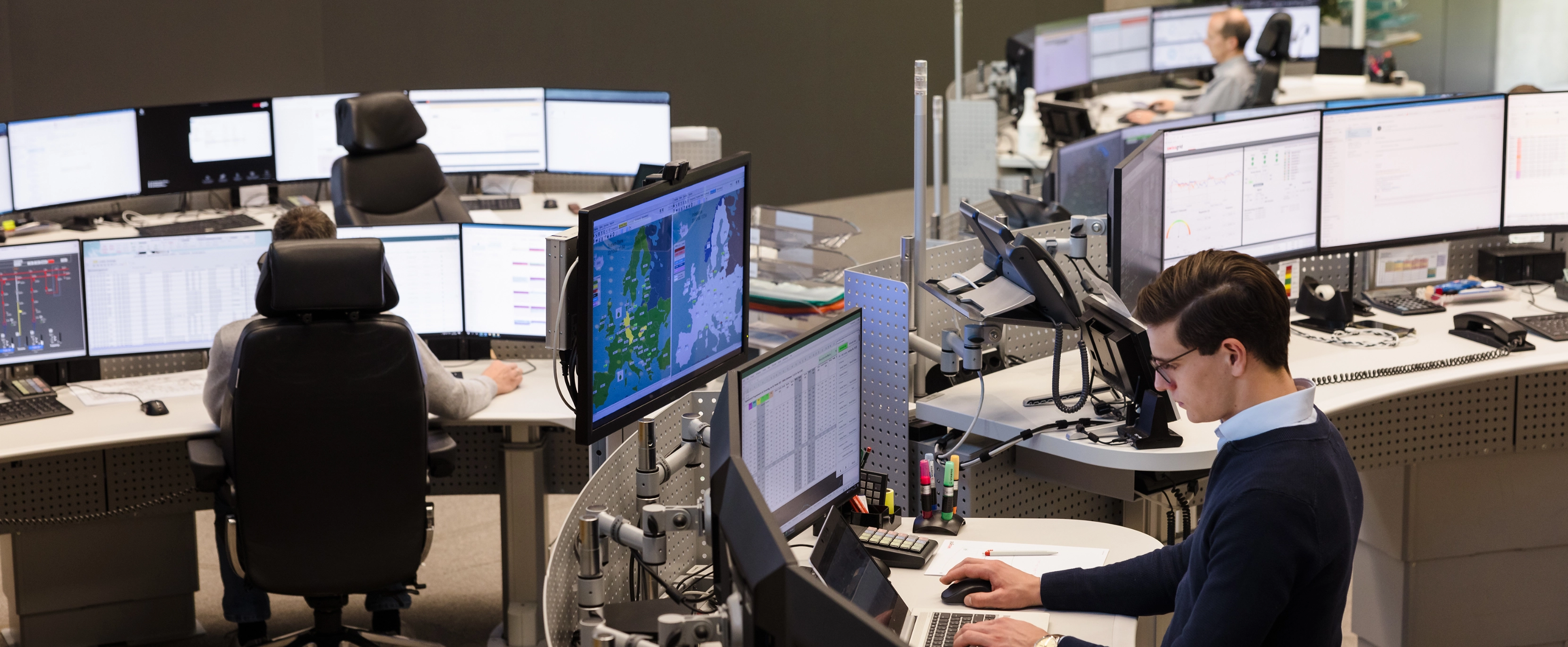
The operator in the grid control room is concentrating hard on the displays on the screens. It’s another one of those days when grid control is going to push them to their limits. The operator’s task is as simple to explain as it is challenging to realise: electricity generation and consumption must remain balanced at all times. This is the only way to keep the system frequency stable at 50 Hertz. Whenever the actual feed-in or consumption deviates from the planned schedule, imbalances occur in the electricity system. Swissgrid must then use control energy to compensate. Deviations can have various causes, such as inaccurate weather or consumption forecasts, short-term changes in power plant operation or exceptional load flows in the international electricity grid.
The main difficulty lies in predicting the extent of the imbalance at an early stage and activating the necessary control energy in the most favourable market. Although the specialists have all the necessary data available, they often don’t have time to analyse this information in full and in good time during busy day-to-day operations. What is more, the complexity in real time exceeds the human analysis capacity. Consistently cost-optimised decisions cannot be guaranteed. This is where artificial intelligence comes in.

The birth of an idea – and the beginning of a long journey
Jacob Tran, Head of Development, remembers the early days of the «Optimizer Autopilot» (the name of the AI tool for automated control energy deployment): «When we look at the current success, it’s easy to forget how long the journey has been. It started with several Master’s theses that identified the potential. But developing a product from a Master’s thesis – that was the real challenge.» The introduction of an internal platform for data processing became the foundation of this pioneering project. A highly motivated team of specialists from Technology, Market and System Operations – brought together technical expertise and operational experience.
A tool that first had to earn trust
When the initial prototype arrived in the grid control room, it was met with scepticism from the team: «We’ve been activating control energy for decades – why should a machine suddenly be able to do it better?» A series of open discussions were held, and some uncomfortable questions were asked: Why doesn’t a tool with such great potential work in everyday life? What are the real obstacles? And how can it specifically alleviate the burden placed on the specialists?
It soon became clear that creative organisational solutions were needed as well as technical adjustments. One idea was unexpectedly effective: as the tool was hardly used in operations – partly because it was so time-consuming – a team of motivated interns was brought in to assist in the control centre. They helped to increase the usage rate of the Optimizer until the automated solution was introduced.
We’ve been activating control energy for decades – why should a machine suddenly be able to do it better?
The turning point in the project
During a joint meeting, the teams involved made a conscious decision to simply give it a try. This pragmatic, bold attitude became a turning point. This was the start of a new phase, recalls Giulio Ferraris, Project Manager Technology: «It meant that we met all the prerequisites to push ahead with the Optimizer. Attention from the Management, strong momentum and a common goal: to make the Optimizer’s usage rate as high as possible.» The previous decision support tool became a fully automated autopilot that integrates its recommendations directly into operating processes. What happened next is remarkable by European standards: between January and May 2025, the joint team brought the solution into productive operation at record-breaking speed.
What does the Optimizer optimise?
- Automatic deployment of control energy
The AI tool decides for itself which control energy is currently required and activates it fully automatically. - Cost-optimised selection
It always selects the most economical tenders, which reduces overall costs. - Better predictions
The AI tool recognises at an early stage how much control energy is about to be needed. - Relieving the pressure of system operation
The AI tool takes over routine work, while the System Operator maintains an overview.
Looking to the future with confidence?
When it comes to the day-to-day work of the specialists in the grid control room, AI takes over the automatic deployment of control energy – and the operators maintain an overview by continuing to regularly check and categorise the results.
Following its successful practical use as a pilot application, the Optimizer is enhanced on an ongoing basis to meet the dynamic requirements of the energy system. These continuous improvements in performance are just the beginning: Swissgrid is expanding the Optimizer into a modular product family that represents the basis for further automation steps. The aim is to extend the efficiency gains to all the relevant challenges in the control energy process.

Author