
Photovoltaic production is expanding rapidly. Today, Switzerland’s installed photovoltaic capacity stands at around 8 gigawatts. According to forecasts by the Swiss Federal Office of Energy, this figure is expected to be five times higher by 2050, reaching around 40 gigawatts. This makes it all more urgent to clarify how photovoltaic energy can be used not only to supply the transmission grid with electricity, but also to stabilise it.
If there is an imbalance between electricity generation and consumption, we must use balancing energy procured via special trading platforms. Today, around 95 percent of the power and energy offered on these platforms comes from hydropower; electricity from photovoltaic plants currently plays only a marginal role in these markets. We want to change that, which is why we have launched the PV4Balancing pilot project in collaboration with the industry. The aim is to demonstrate how photovoltaic plants can be integrated into the market for tertiary balancing energy.
PV installations already make a significant contribution to the Swiss energy mix today. We need to be able to harness this energy for grid stability in the future.
Stefanie Aebi, Co-Project Lead and Senior Specialist Market & Product Design
Products specifically for photovoltaics
Just like any market platform, the balancing energy market offers products for sale, e.g. a specific amount of power in megawatts over a defined period. Designing a product of this kind was the first step in the project and laid the foundations for the successful launch of PV4Balancing.
In specific terms, we have facilitated access to the market; among specialists, this is referred to as a simplified prequalification process. We have also defined fixed remuneration for the power made available. The relevant photovoltaic plants are integrated into real system operation for negative tertiary balancing energy. A total of 97 plants with a maximum output of around 25 MW are taking part in the pilot project. This provides a suitable basis for assessing various technical and process requirements. The smallest plant in the pilot project has a capacity of 63 kilowatts, while the largest has a capacity of 4.9 megawatts – 70 percent of the plants have a capacity of less than 600 kilowatts. This diversity reflects the reality of the situation in Switzerland: most plants are small-scale systems on private roofs; there are only a few large-scale installations. The project gives us and the ancillary service providers valuable insights into key issues.
Power available when needed
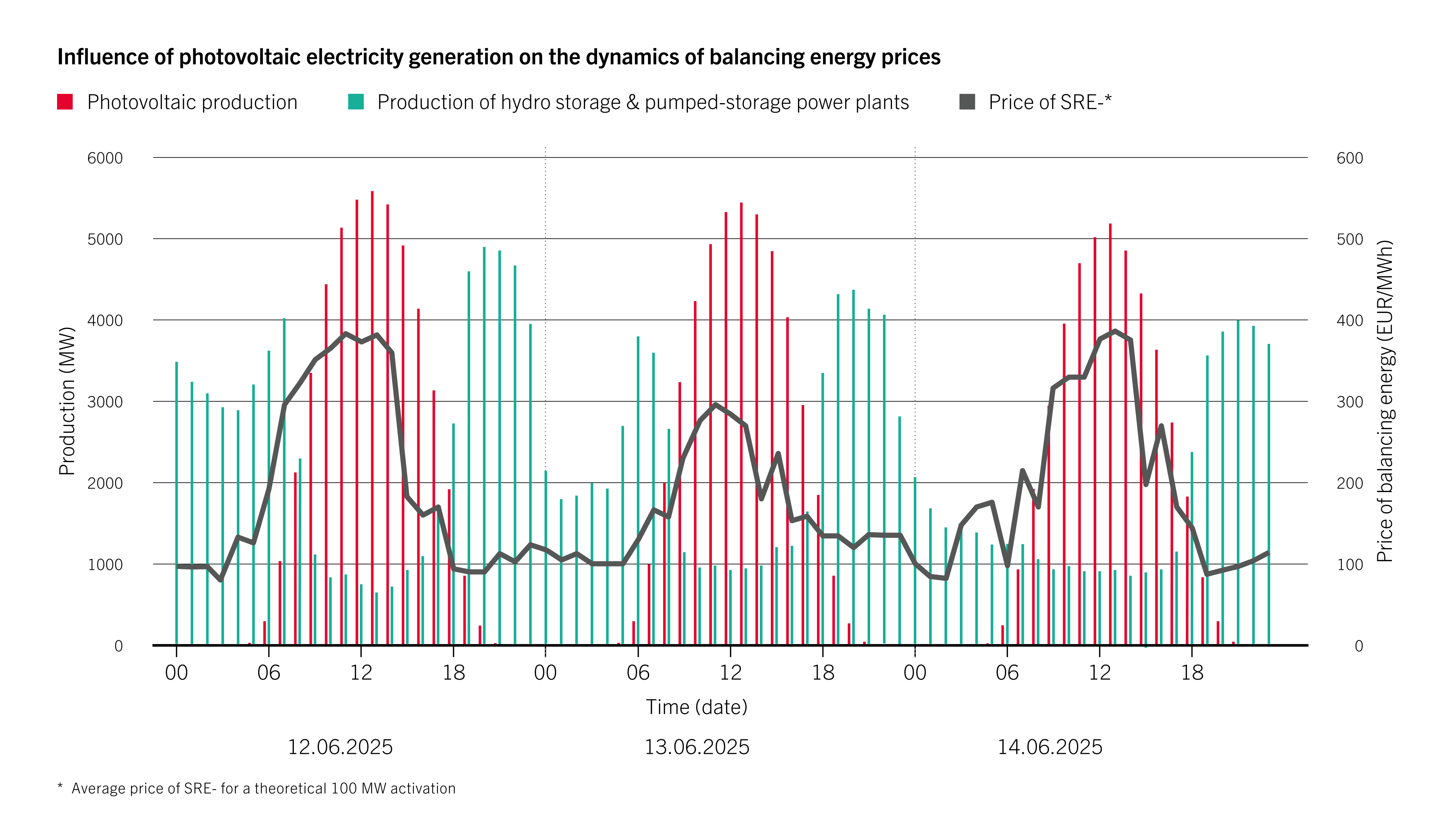
Photovoltaic plants generate the most electricity at midday, when the sun is at its highest point. Consequently, this is also the time when there is the greatest potential for supplying negative balancing energy, i.e. for reducing the amount of electricity fed into the grid.
The pilot project has now shown that negative balancing energy generated by photovoltaics is particularly important at these times of day. This is because traditional suppliers of negative balancing energy, such as storage hydropower plants, often exit the market when there is a lot of photovoltaic electricity available. This is because photovoltaic energy has very low production costs, which drives down spot prices on the power market. This, in turn, forces other power plants to shut down their turbines to avoid selling electricity at a loss. And a power plant that isn’t generating any electricity is unable to reduce its output any further to supply negative balancing energy. This relationship is illustrated in the diagram below.
Pilot project 2.0
The pilot project shows that it is possible to integrate photovoltaic plants into the Swiss balancing energy market. Or, to put it another way, photovoltaic energy can be used to help maintain grid stability. However, this requires framework conditions that are better suited to photovoltaics and smaller providers of balancing energy. One key reason is the significant technological variation across Switzerland's thousands of photovoltaic plants.
Many new insights were obtained during the first phase of the pilot project – underlining the difficulty of integrating photovoltaics into the balancing energy market. We are now continuing the pilot project with additional participants to gain further experience and anticipate the challenges of future market design. In the pilot project 2.0, we are planning to introduce a more flexible, more market-based remuneration system for capacity provision. We are also trialling the inclusion of photovoltaics in power provision. In the future, shorter time slots and a call for tenders held closer to the actual delivery date should even enable participation in the spot market (day-ahead auctions D-1). This shorter time horizon is more adapted to the characteristics of photovoltaic plants and is provided for in the 2026 Balancing Roadmap.
We want to use this as a basis to ensure that in the future, solar energy will not only supply electricity, but also play an active role in stabilising the grid.
Integrating solar installations into the electricity system in a way that helps us stabilise the grid is highly complex. But we are making progress – step by step.
Dona Mountouri, Co-Project Lead and Senior Specialist Market & Product Design
Links
Author