
- The tariffs for Swissgrid’s key responsibility will fall
- Effective measures for congestion management and ancillary services
- The power reserve will cost less, while solidarized costs will rise
The Swiss electricity system is undergoing the biggest transformation in its history. The grid has to keep pace with these changes. Swissgrid uses the tariffs for the transmission system not only to ensure secure operation, but also to finance the modernisation and expansion of the extra-high-voltage grid. This allows Swissgrid to make an important contribution to safeguarding the supply of electricity in Switzerland.
Electricity consumers will pay less for Swissgrid’s services in 2027. An average four-person household (consumption of 4,500 kilowatt-hours per year) can expect to pay around CHF 54 (2026: CHF 64), which corresponds to around 4.5 percent of the household’s total expected electricity costs. Companies that consume 90,000 kilowatt-hours per year will benefit from a cost reduction of 15.6 percent and will only pay CHF 1,086 (2026: CHF 1,286).
Swissgrid will continue to use 35 percent of the proceeds from the auctioning of cross-border capacities to reduce tariffs in accordance with the corresponding decision of the Federal Electricity Commission ElCom.
Extensive measures for a significant drop in tariffs
Swissgrid’s costs – and hence its tariffs – are decreasing thanks to effective measures in the areas of congestion management and ancillary services.
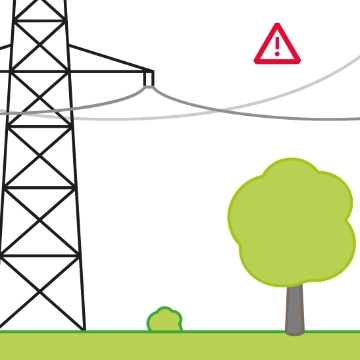
Swissgrid has reduced costs in relation to the tariff for grid usage, for example, thanks to the use of Dynamic Line Rating. This is a monitoring system that determines the loadability of power lines in real time depending on the weather conditions. Swissgrid dynamically adjusts the capacity of the lines and optimises the use of the existing grid. This is an important element in preventing congestion and helps avoid costly interventions in power plant operation.
The measures taken in recent years to increase efficiency with regard to ancillary services (AS) are also having an impact. Participation in the AS market has been made easier for new players such as battery storage systems or bundled smaller systems, for example. This increases the supply available for the provision of control power and reduces costs. However, the costs for the use of control energy are not passed on to electricity consumers via a Swissgrid tariff, but are charged directly to the balance groups that cause the imbalances in the grid.
As far as grid usage is concerned, the working tariff will fall from 0.10 cents to 0.09 cents per kilowatt-hour. Swissgrid will charge 0.19 cents per kilowatt-hour for general ancillary services next year (2026: 0.27 cents) and 0.08 cents per kilowatt-hour for active power losses (2026: 0.20 cents). Swissgrid will now charge 1.62 cents per kilovar-hour for voltage maintenance (reactive energy) (2026: 1.81 cents).
Lower tariff for the power reserve
The tariff for the power reserve is also being reduced. However, the expected costs for the new reserve power plants are likely to lead to an increase in this tariff in the future. The power reserve (reserve power plants, emergency power groups and the hydropower reserve) is the responsibility of the federal government, but the costs are passed on to electricity consumers by Swissgrid. The tariff for the power reserve will be 0.17 cents per kilowatt-hour in 2027 (2026: 0.41 cents). This means that an average four-person household will pay around CHF 8 per year for the power reserve (2026: CHF 18).
The tariff for solidarised costs will increase
The only tariff that will increase in 2027 is the surcharge for solidarised costs via the transmission system. This represents costs charged by Swissgrid that are not incurred by the company itself. More specifically, this tariff covers the costs of grid enhancements in the distribution grids and the reduction in grid utilisation costs granted to the Swiss steel and aluminium industry. The tariff for these solidarised costs will be 0.19 cents per kilowatt-hour next year (2026: 0.05 cents). This will cost an average four-person household around CHF 8 per year (2026: CHF 2).