
Swissgrid is responsible for the project planning for and implementation of transmission lines. The Swiss government’s approval procedure, which consists of six phases, must be complied with. The concerns of the various stakeholders play a key role in this procedure, and it gives a number of players the opportunity to provide their input. At the end of the procedure, the authorities decide on the corridor and technology that will be used to construct a line.
Accelerating grid expansion
The period from the start of a project through to the commissioning of the relevant line is currently around 15 years. However, objections and court judgements at a late stage often lead to significant delays in projects – and they can take up to 30 years.
The modernisation of the grid infrastructure is critical for the success of the Swiss government’s energy strategy. However, grid expansion cannot keep pace with the expansion of renewable energies. What is more, structural congestion already exists in the transmission grid. Swissgrid needs to instruct power plants to limit their production on a regular basis. It is therefore vital that grid expansion is accelerated through efficient approval procedures. Swissgrid has defined all the grid projects that are essential for a secure and reliable Swiss transmission grid in the report «Strategic Grid 2025».
The Swiss government's sectoral plan process
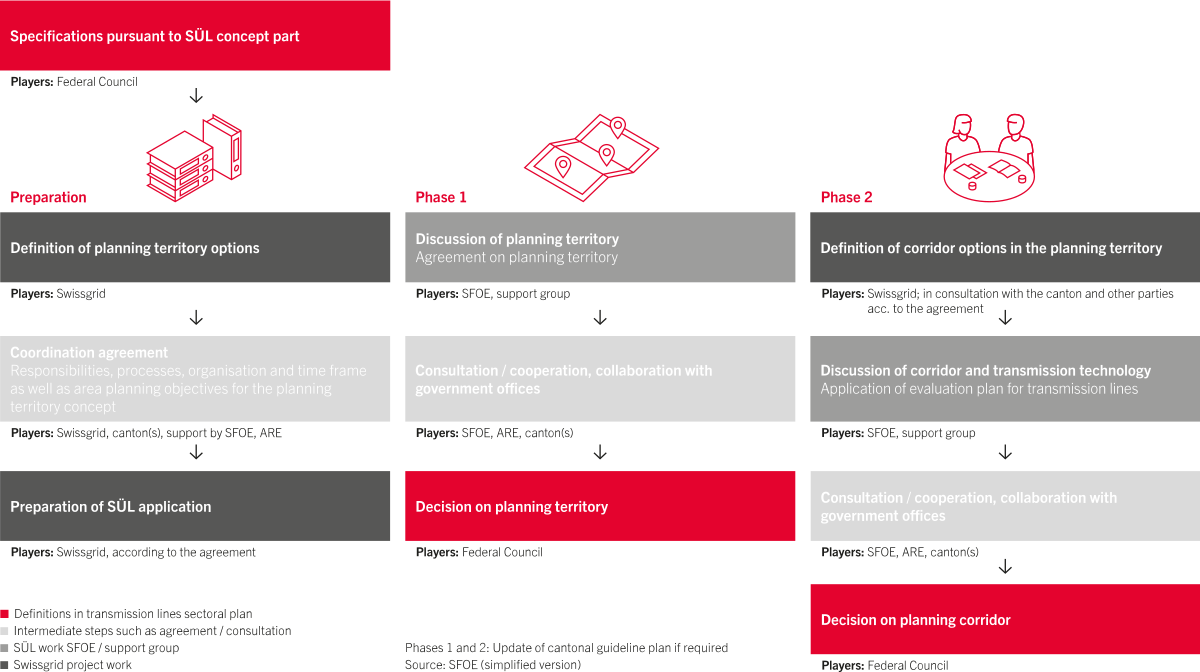
The process
The sectoral plan for transmission lines is the government’s overarching planning and coordination tool for the development and new construction of transmission lines (220 and 380 Kilovolt) and railway power lines (132 Kilovolt). The sectoral plan process is a regulatory process by way of which a line construction project is assessed from an area planning perspective, is reviewed in relationship with the existing and future utilizations as well as compatibility with the protected areas, and a planning corridor is defined.
Preparatory phase
Before the actual sectoral plan process can be launched, Swissgrid and the cantons involved conclude a coordination agreement. This guarantees that the interests of the cantons are incorporated into the planning at the earliest possible stage. The sectoral plan process starts with the submission of the application for inclusion in the sectoral plan for transmission lines (SÜL application) by Swissgrid, in which proposals for planning territories are put forward.
Phase 1
On the basis of the planning territory proposals made by Swissgrid in the SÜL application, the support group deployed by the Swiss Federal Office of Energy (SFOE) makes its recommendations. Within the planning territory, several corridor options should be possible.
Phase 2
Swissgrid draws up various corridor options within the defined planning territory. The support group then recommends one planning corridor using, if required, the «Evaluation Plan for Transmission Lines».
The government decides on both the planning territories and the planning corridor on the basis of the support group recommendations. The planning territories and the corridor are then set out in the sectoral plan based on these decisions. Within the planning corridor defined by the government, Swissgrid can then work out the concrete line routing during the detailed phase of the project, which follows the sectoral plan process.
Involvement options in the sectoral plan process
Support group
The support group is put together by the Swiss Federal Office of Energy (SFOE). It provides assistance with the definition of the planning territories and with the definition of the planning corridor and makes recommendations.
The support group comprises representatives of the interested Swiss federal offices (ARE, SFOE, BAV, etc.) and of the ESTI, the ElCom, the cantonal authorities involved, organisations under private law (e.g. environmental protection organisations) and Swissgrid. Independent experts are also asked to assist where necessary.
Consultation and cooperation process in accordance with Art. 19 of the Area Planning Directive (RPV)
Prior to the relevant definitions being laid down by the government, any private person may issue a statement on the support group recommendations by way of the consultation and cooperation process.