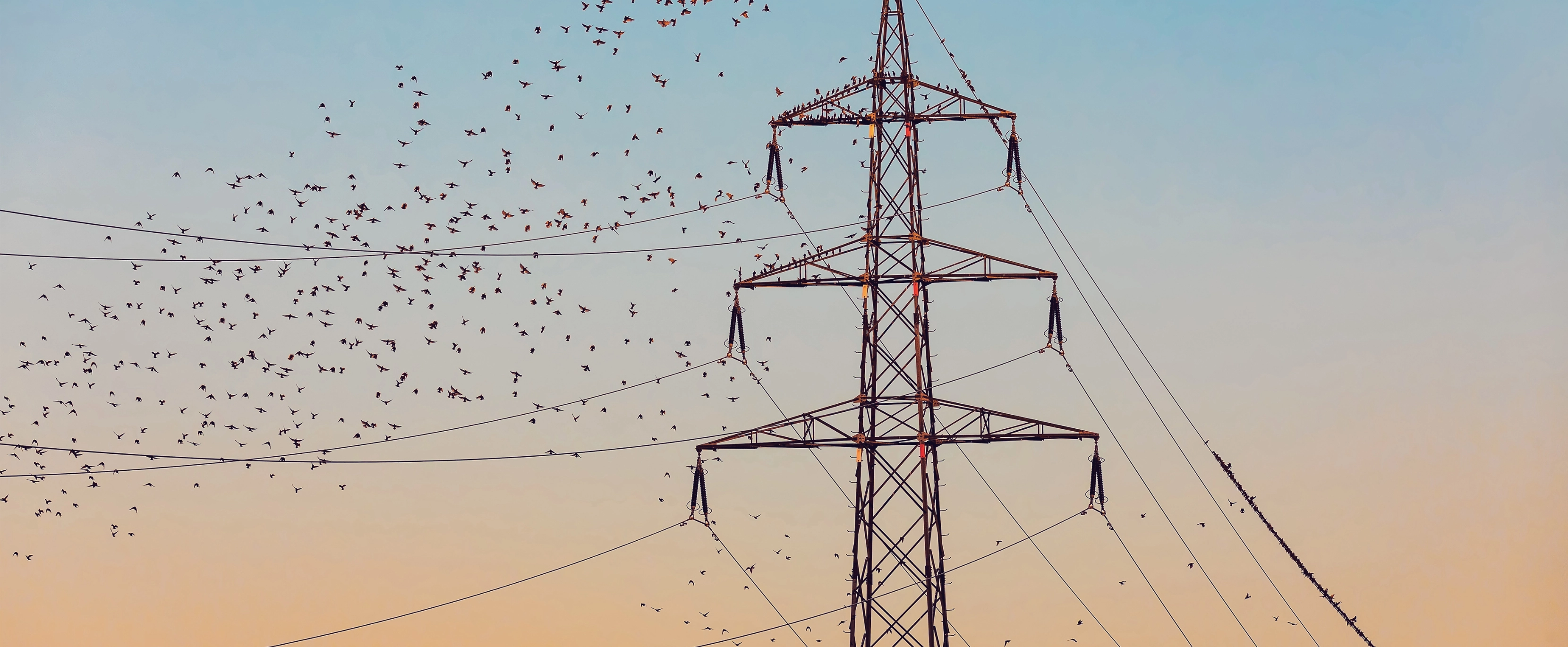
Electrically speaking, a line in Switzerland’s transmission system consists of three phases that transport the electricity. Each phase comprises one or more conductors, known as bundle conductors. Conductors are made of aluminium and have a diameter of 2.8 to 3.6 centimetres. There is also a ground wire running from the top of one pylon to the next. This is thinner than the conductors and serves for earthing, which protects against direct lightning strikes.
How dangerous are extra-high-voltage lines for birds?
Overhead lines cause only a small proportion of accidental deaths in many species, but an extremely high percentage in others. Various studies show that, in principle, different bird species can be affected by accidents on overhead lines, but to varying degrees. We take a closer look at two potential dangers:
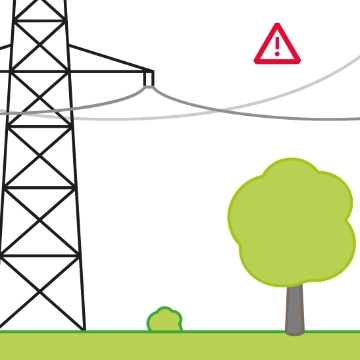
Electrocution: the mortality rate of birds due to electrocution is comparatively low for extra-high- voltage lines (220 / 380 kV). This is due to the fact that the conductors of different phases are positioned at a considerable distance from each other on the transmission lines. If a bird flies between the conductors, its wingspan is not sufficient to trigger a short circuit. Consequently, the bird does not get electrocuted. But the lower the voltage level, the greater the risk, because the distance between the conductors is smaller. A safety distance of 1 centimetre per 1,000 volts must be maintained. On a 220,000-volt line, the distance from the wires to the pylon and to the ground or even to trees must therefore be at least 2.2 metres. On a 380,000-volt line, the minimum distance is 3.8 metres. If the distance is too short, there is a risk of an electric arc forming. This is when the current is transmitted through the air – like lightning.
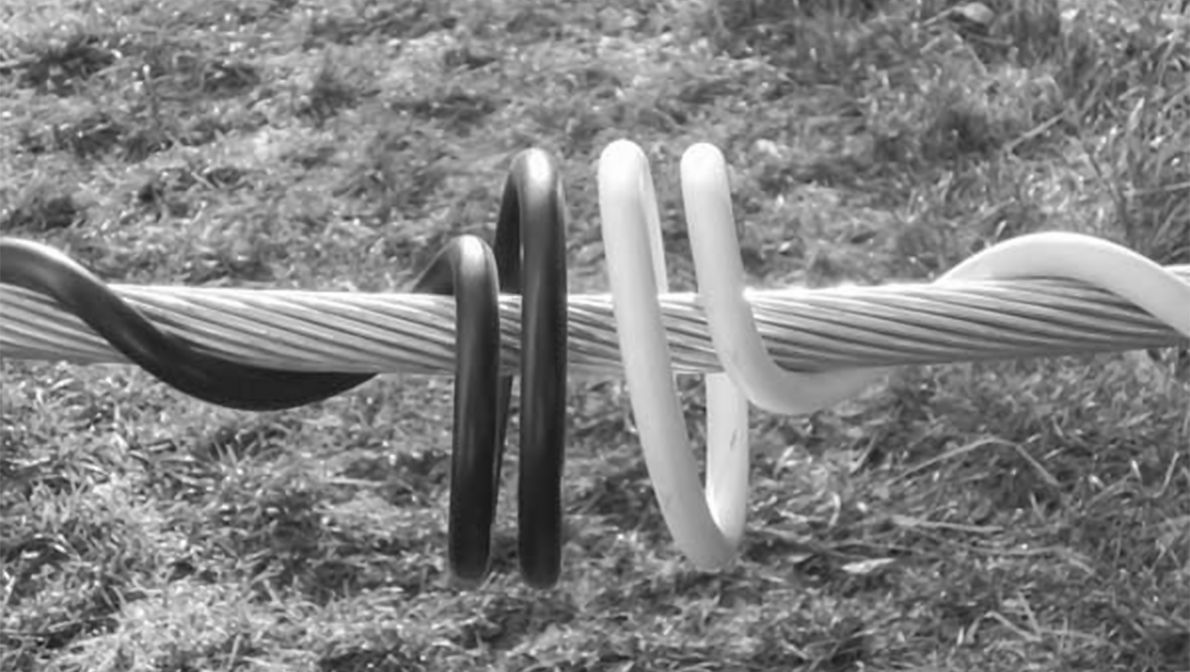
Collision: the risk of collision depends mainly on the location of the transmission line. If line sections overlap with the habitats and space used by potentially affected bird species, the risk of collision increases. Most collisions involve the ground wire. This is much thinner than the conductors and is therefore the least visible. The ground wire poses a danger when birds swerve upwards at the last moment to avoid the conductors. Thanks to the use of bundle conductors and a thicker ground wire, the number of collisions can be reduced. Where there is an increased risk of collision, e.g. at river crossings or in near-natural habitats, Swissgrid uses black-and-white conductor markings as an effective protective measure.
The mortality rate of the vast majority of bird species is generally very high in the first year of life. To keep population levels stable, an average of about 33 percent of adult and young birds must survive until the next breeding season. Let’s take a look at the Engadine, where large numbers of birds make their home. According to the environmental impact report conducted as part of the project to extend the extra-high-voltage line between Pradella and La Punt, the proportion of fatalities caused by the line was found to be about 3 percent of the total population of all birds at the end of the breeding season. At first glance, this value does not seem particularly high.
Safety first
Nevertheless, losses can be considerable for rare or endangered species and bigger species with wide wingspans. As the size of a bird species increases, the number of broods per year and the number of offspring per brood decreases. The death of an eagle owl due to electrocution or a collision therefore weighs much more heavily than that of a mountain finch or a blackbird. Swissgrid takes its responsibilities seriously by implementing various measures to protect birds.
- For each grid project, Swissgrid examines both overhead line and cabling options. Whenever new overhead lines are built, Swissgrid chooses a route that avoids highly sensitive areas such as waterbird and migratory bird reserves of national importance as far as possible. The (partial) cabling of lines is also investigated by Swissgrid for specific projects.
- The distance between cross-arms that birds perch on and live elements must be calculated in such a way that no earth faults or short circuits occur.
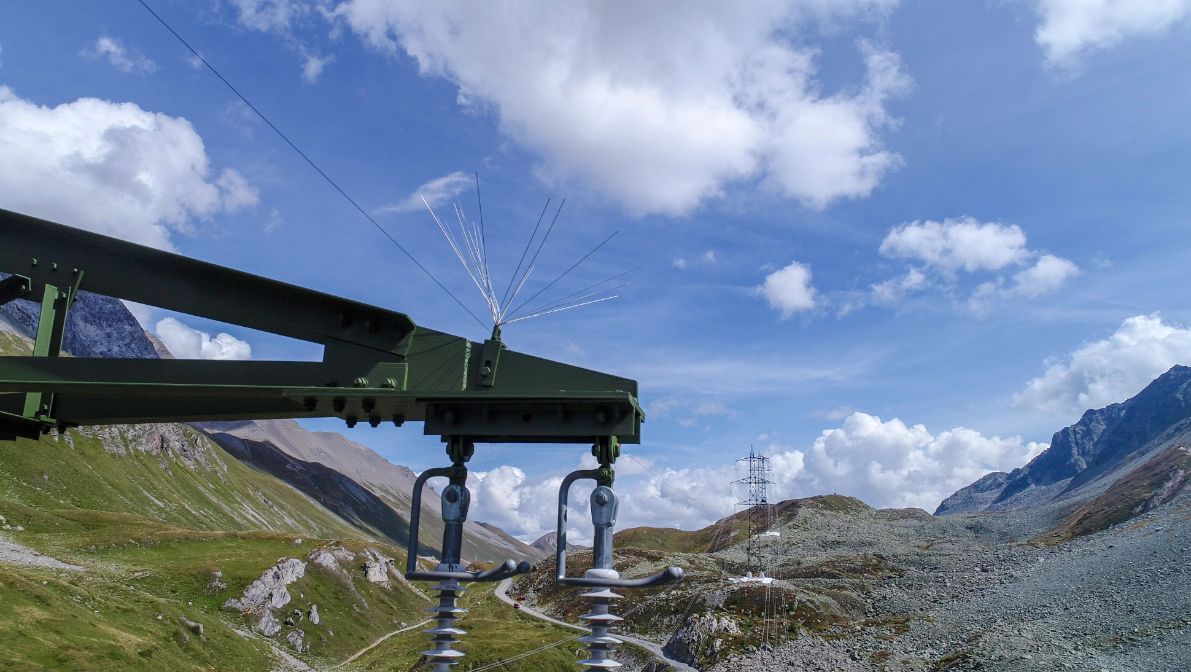
- Depending on the local conditions, precautions can be taken on the supporting structures (pylons) to avoid earth faults and short circuits. One way of doing this is to install insulation elements, high-contrast conductor markings or devices referred to as «bird brooms».
- The main flight path of migratory birds is along the Alps. Lines running perpendicularly to the direction of the valley represent a high potential hazard. River and lake crossings are examples of other sensitive areas. Swissgrid plans and constructs lines in such a way that the risk of collision is as low as possible in areas with sensitive habitats, areas where national priority species are found, or areas crossed by bird migration routes.
- When carrying out a project in a sensitive area, Swissgrid ensures that as much line construction work as possible takes place at a suitable time of year. This avoids disturbance, especially from helicopter flights, during the breeding season.
«The FOEN welcomes Swissgrid’s commitment to implementing measures for the protection of birds on overhead lines. Thanks to local measures to reduce the risk of electrocution and collision, Swissgrid is living up to its responsibility to provide a secure electricity supply whilst ensuring species protection.»
Federal Office for the Environment (FOEN)


Nesting boxes for bird species that are particularly at risk have been built by initiators in association with Swissgrid as part of some projects. For example, nesting boxes for jackdaws or kestrels. Does that sound interesting? Read the blog post here: Birds move to the extra-high-voltage grid
And in case you are now wondering whether a human could sit on an extra-high-voltage line without being injured, the answer is yes, as long as the person stays far enough away from other conductors, the pylon, the ground, or any other objects that conduct electricity. Nevertheless, we humans should stay away from power lines – even during sports activities in the air. You can find all the information you need on how to protect yourself and how to behave near power lines here: Behaviour near lines
Author