A new 380 kV connection between Airolo and Lavorgo will replace the existing high-voltage line, allowing greater security of supply for Ticino and Switzerland. The new route is planned on the right side of the valley, away from built-up areas.
Electricity is essential for our society and economy. Swissgrid’s transmission grid is crucial for transporting electricity from the power plants to people’s homes. In the coming years, energy requirements will increase steadily, driven by electrification of the mobility sector and of heating (heat pumping technology), as well as the creation of data centres, which are large consumers of energy.
Swissgrid wants to make a decisive contribution to this transformation by adapting its electricity grid to the new conditions. That is why it recently updated its long-term grid planning and identified 31 key projects, with the aim of continuing to ensure a secure supply of electricity in the future.
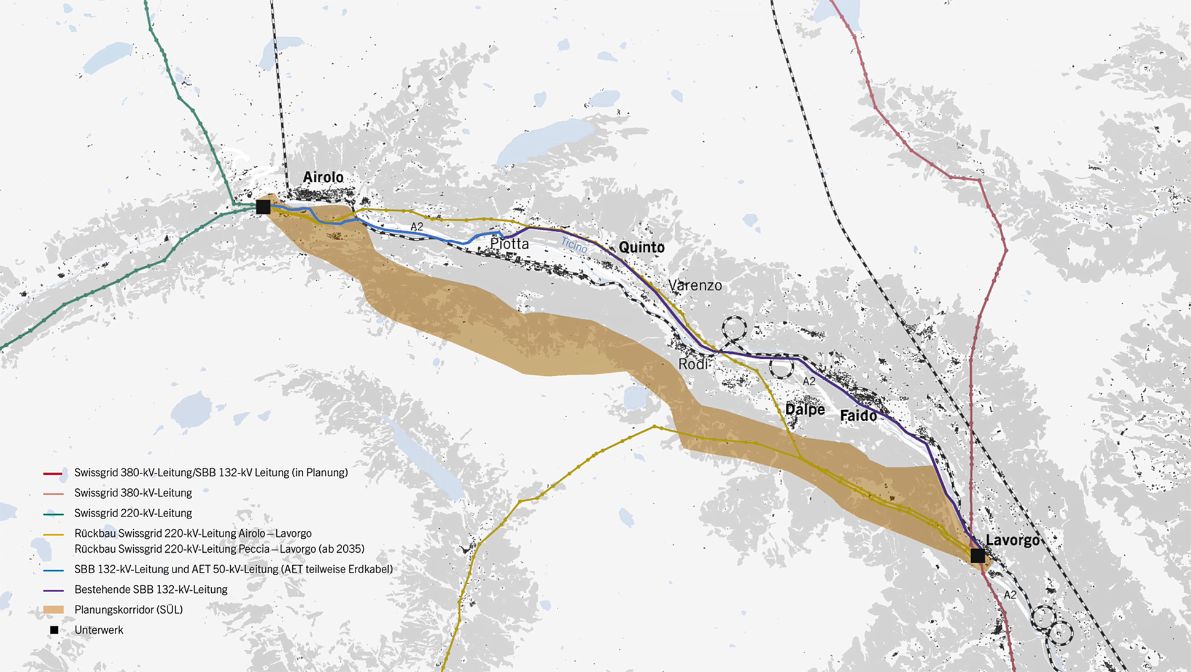
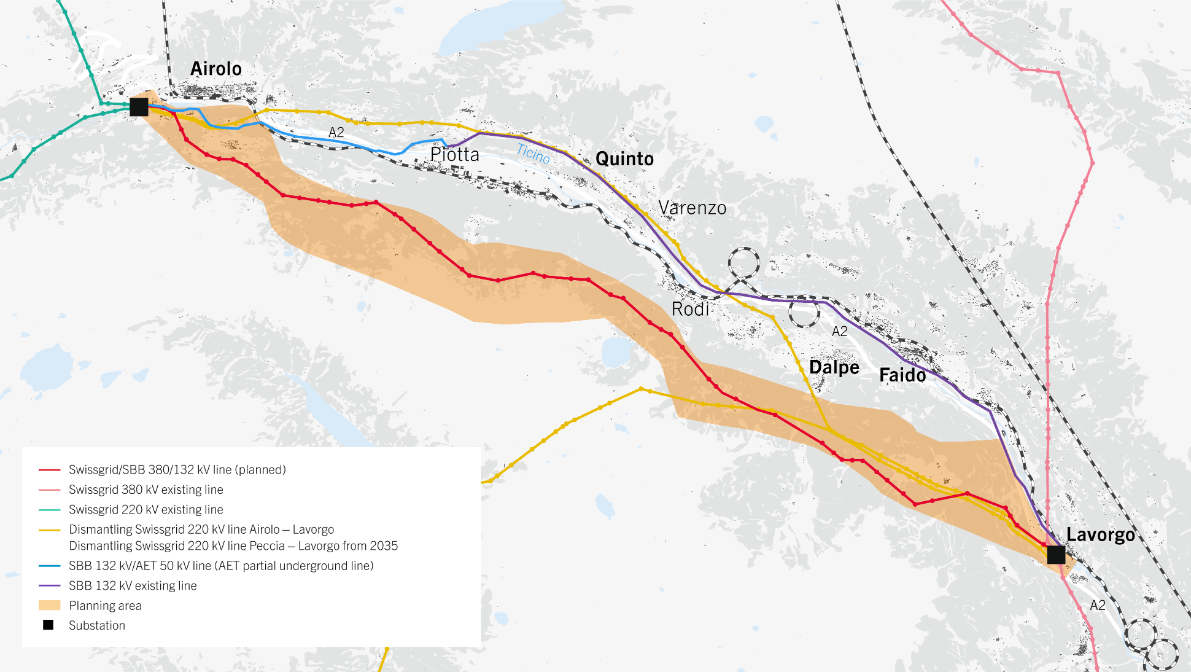
Swissgrid plans to replace the existing high-voltage line between Airolo and Lavorgo with a new 380 kV overhead line. The line currently in use was built in the 1950s and no longer meets current needs. The new route is 23 km long and will pass along the more shaded side of the valley, away from built-up areas. A 132 kV SBB line will be bundled on the same pylons, which will power the AlpTransit Gotthard railway line as well as the two other existing lines. Once the work has been completed, the existing line will be dismantled. As a compensatory measure, the AET line to Quinto, Rodi and Faido will be partially cabled.
A SBB 132 kV line will be bundled on the same pylons, which will power the AlpTransit Gotthard railway line.
The line is required to guarantee sufficient energy supply in Ticino and Switzerland. Currently the existing lines in Upper Ticino are inadequate and overloaded, which puts a limit on production at the hydroelectric power plants in Ticino. Swissgrid submitted an application for a construction permit in May 2020, and the planning approval process is still ongoing.
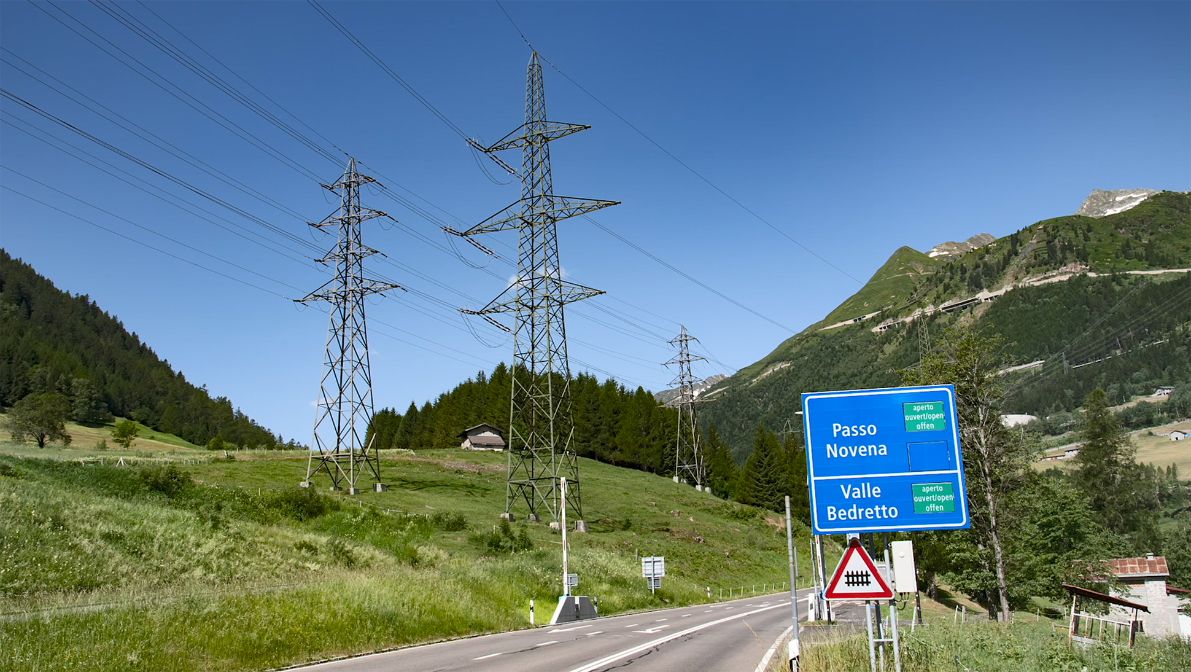
1/2: Animation of the future line Airolo – Lavorgo
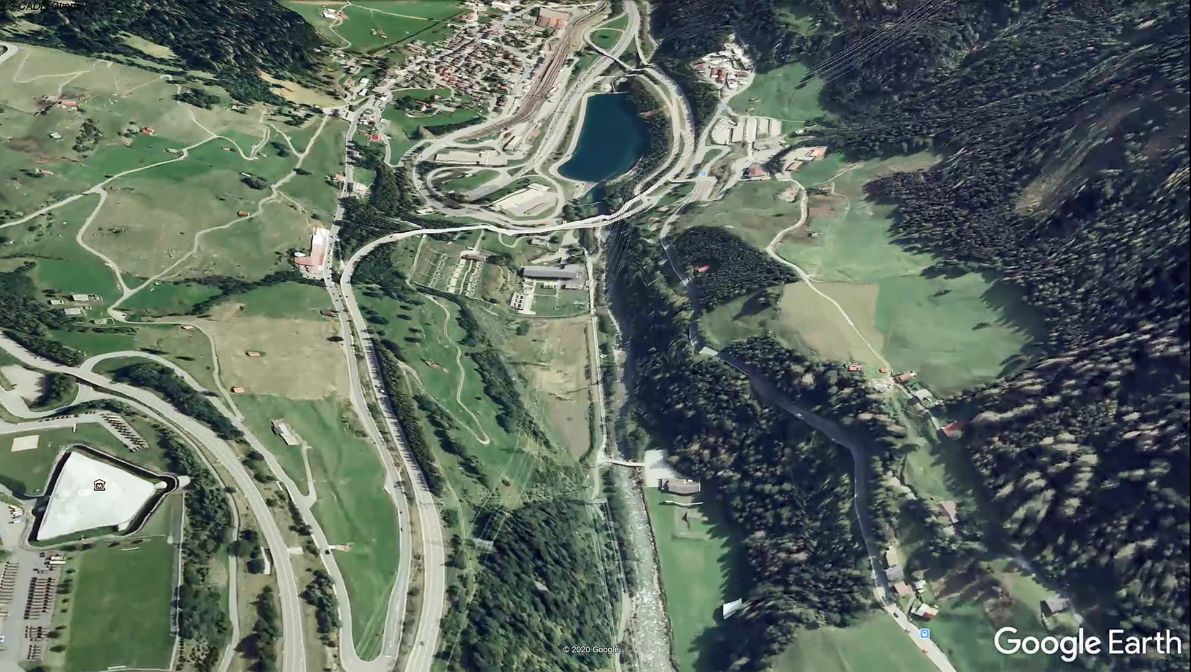
2/2: Visualisation of the new line (Google Earth)
Improvement compared to the current situation
Increased operational safety and security
Line constructed away from build-up areas
Dismantling of Swissgrid’s existing 220 kV Airolo – Lavorgo and Peccia – Lavorgo lines (the latter from 2035, once the new lines in Vallemaggia are commissioned)
With the increased transmission capacity, limits on production at the power plants in Ticino will be avoided
Partial burial of the AET 50 kV line
The new FFS 132 kV connection will improve security of supply to AlpTransit Gotthard
Project
The fruit of cooperation with the canton, AET and SBB
In November 2013, the Canton of Ticino, Swissgrid, AET and Swiss Federal Railways (SBB) jointly decided to carry out a «General study on the high-voltage grids of Ticino» in coordination with the Swiss Federal Office of Energy (SFOE). The aim of this study was to look for variants that would be better suited to the specific characteristics of the area and could be considered part of an overall vision for Upper Ticino rather than simply the Leventina district. In an initial phase, the study examined the zone designated as the «Upper Ticino – Western Part» section, which includes Vallemaggia and Locarnese up to Magadino, Val Bedretto and Upper Leventina up to Lavorgo.
From the 70 possible solutions identified in the study for reorganising the transmission lines, the SFOE and the project support group unanimously chose the «Leventina + 14» variant. Among other things, this solution will relieve valuable areas of more than 70 km of overhead lines, which will be removed. The dismantling will take place in stages and will be completed once all the new lines planned in Leventina and Vallemaggia have been commissioned.
New route and increase in voltage
The upgrade project is part of Swissgrid’s Strategic Grid 2025 and is of national importance. Thanks to this new overhead line, a second 380 kV connection will be established between the Canton of Ticino and the rest of Switzerland (in addition to the Lucomagno Mettlen – Lavorgo line), thus improving the energy transmission capacity. A SBB 132 kV line will also be bundled on the same pylons of the new high-voltage line. SBB will therefore have greater security of supply for the AlpTransit Gotthard railway line.
Once commissioned, it will be possible to dismantle the existing 220 kV line that in some places runs close to built-up areas. In addition, as a compensatory measure, the AET 50 kV line will be partially cabled.
The new line will be 23 km long and will run along the right side of the valley. There are four municipalities involved in the project: Airolo, Quinto, Dalpe and Faido. The planned investment amounts to more than CHF 90 million, about 25 million of which are earmarked for compensatory measures.
Chronology and next steps
The possibility of increasing the voltage between Airolo and Lavorgo was first examined in 1997, when the extra-high-voltage line was still owned by Atel. In 2006, a decision was made to integrate the SBB line into the project, while in 2012, a support group for the Swiss Federal Office of Energy was set up to assess the full cabling or partial cabling variants.
2013 was a milestone for the project: Swissgrid became the owner of the national electricity grid, and the canton launched the general study on the high-voltage and extra-high-voltage grids. This study has led to a total reorganisation of Upper Ticino, which will enable the dismantling of more than 70 km of overhead lines, confirming the necessity of the Airolo – Lavorgo project.
In 2015, the support group defined the corridor on the right side of the valley and the technology to be used (overhead line). This recommendation was the subject of a public consultation in the local municipalities during the summer. On 23 March 2016, the Federal Council approved the corridor and the technology. On the basis of this decision, Swissgrid developed the definitive route and submitted the application for a construction permit in May 2020. The project was published in the relevant municipalities in June 2020.
At the beginning of 2024, the Swiss Federal Office of Energy (SFOE) suspended the planning approval process and asked for further clarifications on the project from Swissgrid, in particular regarding the routes of the AET and SBB lines in Airolo and Lavorgo and the dismantling of Swissgrid’s current Airolo – Lavorgo line. In addition, updates of the environmental impact study and the partial cabling study in Airolo were requested.
However, the basic parameters of the project and the route of the Swissgrid line remained unchanged. Swissgrid updated the project dossier and submitted it to the SFOE again in the autumn of 2025. The new publication of the project is likely to take place in the first half of 2026. At the same time, municipal authorities and private individuals will have the opportunity to submit their objections.
It is now up to the Swiss Federal Office of Energy to make a decision on granting the construction permits. This decision may in turn be challenged. In this case, the Federal Administrative Court and the Federal Supreme Court will decide whether the SFOE’s provisions are fair and, in the event of an appeal by the parties affected, whether the law has been correctly applied.
Technical data
Voltage
380 / 132 kilovolt
Route length
23 kilometres
Number of pylons
59
Conductors
Aldrey 1000 and Aldrey 800
Partner
SBB
People & environment
The Airolo – Lavorgo project is an important step not only for energy security, but also for the harmonious integration of infrastructure and territory. Thanks to the bundling of lines, the overall impact on the landscape has been reduced by avoiding the construction of separate pylons. The general study identified the most suitable areas for the new routes, carefully evaluating every landscape and regional planning aspect. This approach made it possible to fit the new line into its natural surroundings in the most balanced way possible. It should also be considered that overhead lines have less environmental impact than underground cables in general (see blog: Overhead lines – an underestimated contribution to sustainability).
Finally, Swissgrid is committed to mitigating the impact of the line on the landscape and the environment, within the parameters set by the federal authorities. The environmental impact report identified a further 100 nature conservation projects. These measures include the monitoring of the golden eagle and black grouse, as well as the restoration of cascades (such as the Trenta Valli cascade) and the restoration of wooded pastureland for agriculture.
Landscape
The measures undertaken to benefit nature also include the dismantling of the existing line that currently runs alongside built-up areas, and the partial burial of the AET line. The new high-voltage line will be constructed away from built-up areas and will be located on the more shaded side of the valley.
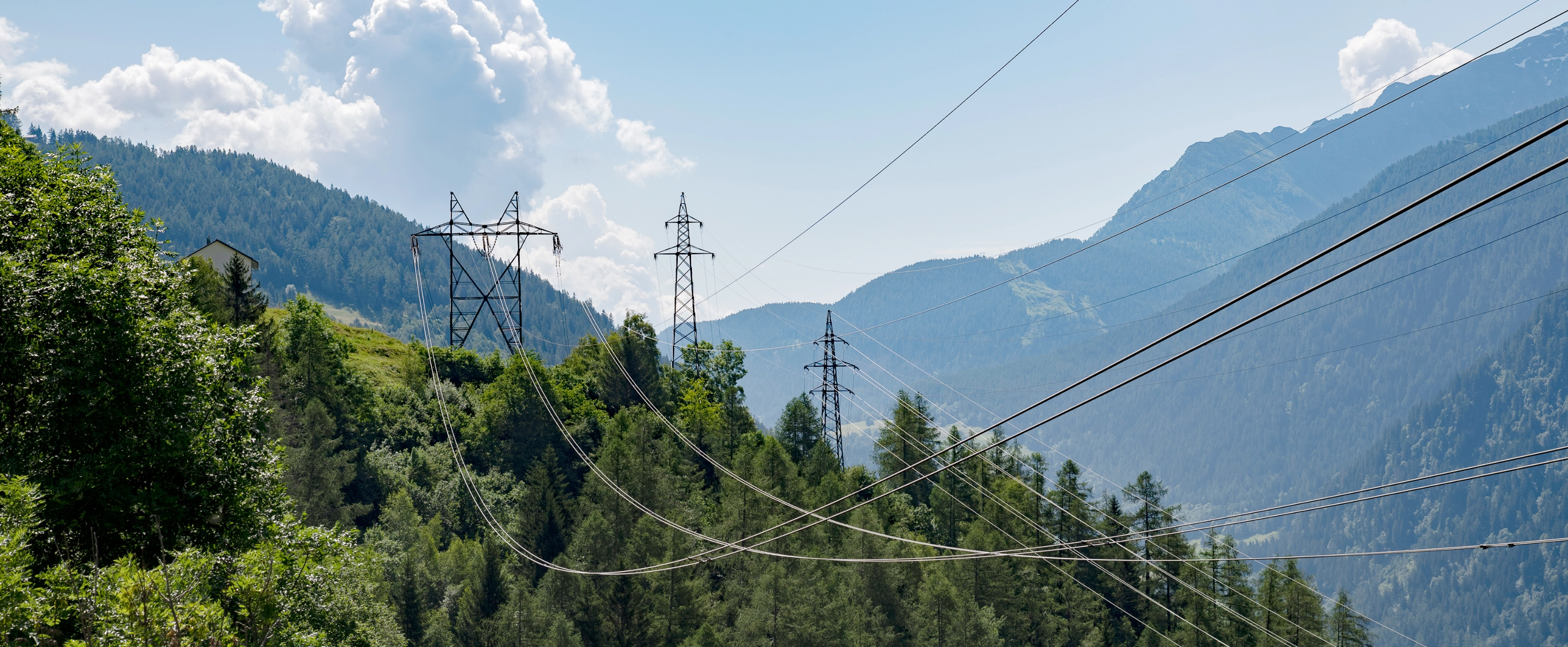
Bundling the new Swissgrid 380 kV line with the SBB 132 kV line will avoid the requirement to construct two independent sets of pylons – all for the benefit of the landscape. The new pylons will be supplied already painted green so that they blend in with the surrounding woods.
In some areas, clearing will be required, which could make the line slightly more visible for the first few years. Low trees will be planted, making the pylons less visible.
To define the route, Swissgrid decided to talk to the municipalities and «patriziati» (public entities managing collective properties). Numerous inspections and photomontages were carried out, which were then optimised at numerous meetings with the local authorities.
Electromagnetic fields and noise
The further the line from the surrounding villages, the less of a burden it will be on the population. The limit of 1 μT for electromagnetic radiation will be complied with at all times or perhaps not even reached. Noise pollution will be notably reduced thanks to the use of the latest technology and two-conductor bundles.
Natural hazards
To develop the project, Swissgrid relied on natural hazard experts. For the Tremorgio crossing, for example, an assessment was carried out by the Swiss Federal Institute for Snow and Avalanche Research at Davos. The granting of the construction permit was subject to strict conditions. Some of them involved checking, in collaboration with geologists and engineering firms in the canton, whether protective measures are necessary at the pylons. Potential natural hazards include landslides, debris flows, avalanches and rockfall.
This website uses cookies. By continuing to use this website you agree to the use of cookies. More information can be found in the privacy policy or the legal information.