en

Connecting a system to the transmission grid

Switzerland has several grid levels with different voltage levels and responsibilities. Swissgrid is the owner and operator of the highest voltage level, which is known as the transmission system or transmission grid (grid level NE1). This is primarily used to transport large volumes of energy over long distances, to supply underlying grid levels and the distribution grids, and to transport the electricity produced by large power plants.

Requirements for a grid connection to the Swiss transmission grid

The following requirements must be met in particular in order for a system to be connected directly to the Swiss transmission grid:

The minimum installed load of systems (feed-in or feed-out) connected to the Swiss transmission grid is:
  • 150 MVA at the 220-kV grid level
  • 300 MVA at the 380-kV grid level
The local distribution system operator is responsible for installed loads of less than 150 MVA and must be contacted directly.
The following requirements must be complied with. Please study them before submitting your grid connection application:
To plan and estimate the cost of a connection, Swissgrid needs information that is as precise as possible regarding the planned location of the systems to be connected. A location close to an existing Swissgrid substation is an advantage (see grid map).
Swissgrid requires confirmation in the application form that the operation of the systems to be connected at the planned location is possible in accordance with the zoning regulations.
The security conditions for electrical systems operated by Swissgrid and/or partner systems must be guaranteed at the planned location (e.g. distances to be observed in accordance with the «Ordinance on Electric Lines and Cables (Lines Ordinance, LineO)» ).
A grid connection transformer represents the connection element for the systems to be connected to the transmission grid. The grid connection transformer and all the systems connected behind it are the property of the grid connected party. They are to be procured, constructed, operated and maintained by the grid connected party, and must be located on land owned by the grid connected party or land for which they have construction rights.
The costs for the construction of the connection are borne in accordance with the General conditions for the connection to the Swiss transmission system (ABNA). Swissgrid collects a grid connection charge from the grid connected party. The grid connection systems at transmission grid level are owned by Swissgrid and are procured, constructed, operated and maintained by Swissgrid.
Swissgrid may require the grid connected party to provide a financial guarantee that the costs incurred in connection with the grid connection can be borne.
The grid connected party must commission an operator with the necessary qualifications to operate its systems. See the General conditions for the connection to the Swiss transmission system (ABNA).
Swissgrid is not an energy supplier or consumer (with the exception of ancillary services, by means of a separate agreement). The grid connected party must conclude a supply or purchase agreement with a supplier or customer. Energy is exchanged in its supply network on NE1.

Connection of battery storage systems

In the context of the transformation of the energy system, flexibility is becoming increasingly important in the transmission grid. The connection of battery storage systems and other energy storage systems therefore plays a crucial role.

You can use your storage system to provide ancillary services and thereby contribute to the stability and efficiency of the grid, while also benefiting from market-based tenders. To participate in tenders, you must prequalify your system.


Estimated time until commissioning

Based on current experience, the commissioning of a connection takes between three and ten years after receipt of the application. The construction time required is determined in particular by land acquisition, authorisations, delivery times for the electrical components that need to be procured and capacities for the implementation work.


Capacity map

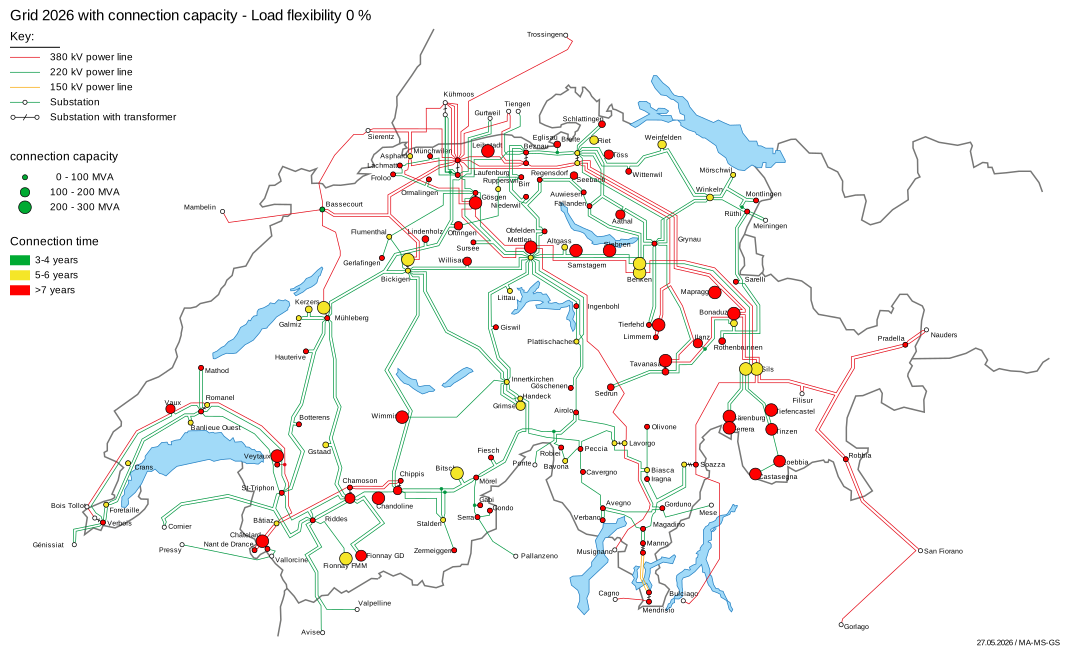
Swissgrid has drawn up maps to make the connection process more efficient and to assist project engineers. The maps provide an indication of which substations have available capacity. Since capacities change as grid expansion continues, different time horizons are shown.

Connection capacity grid 2026

Please note: the connection capacities shown on the capacity maps are intended for guidance only. The figures are indicative and are subject to verification on a case-by-case basis, according to the latest assumptions and information available. No entitlement to a grid connection or grid access can be inferred from the information given on the capacity maps.

In addition, Swissgrid will introduce a flat-rate application fee for new grid connection applications from 1 June 2026. This fee will apply to transmission grid connection applications for large-scale batteries, data centres and power plants.


Application fee

From 1 June 2026, Swissgrid will charge applicants a flat-rate application fee to cover the processing costs incurred by Swissgrid. This does not apply to connection applications submitted solely for the distribution grid. Swissgrid will invoice the flat-rate fee from the date the application is submitted. The application will only be deemed to have been received once the flat-rate fee has been paid and all the information required on the application form has been provided. The application fee is non-refundable.


Submission of a grid connection application

If your project meets the requirements for a grid connection to the Swiss transmission grid, you can submit a grid connection application (in German) to Swissgrid. Please send the completed application form to netzanschluss@swissgrid.ch.

The application will only be deemed to have been received once the application fee (see above) has been paid and all the information required on the application form has been provided.

Downloads

Contact

Title

Please select a title.

Please enter your first name.

Please enter your last name.

Please enter a valid e-mail address.

Please enter your message.

Please click the checkbox.