

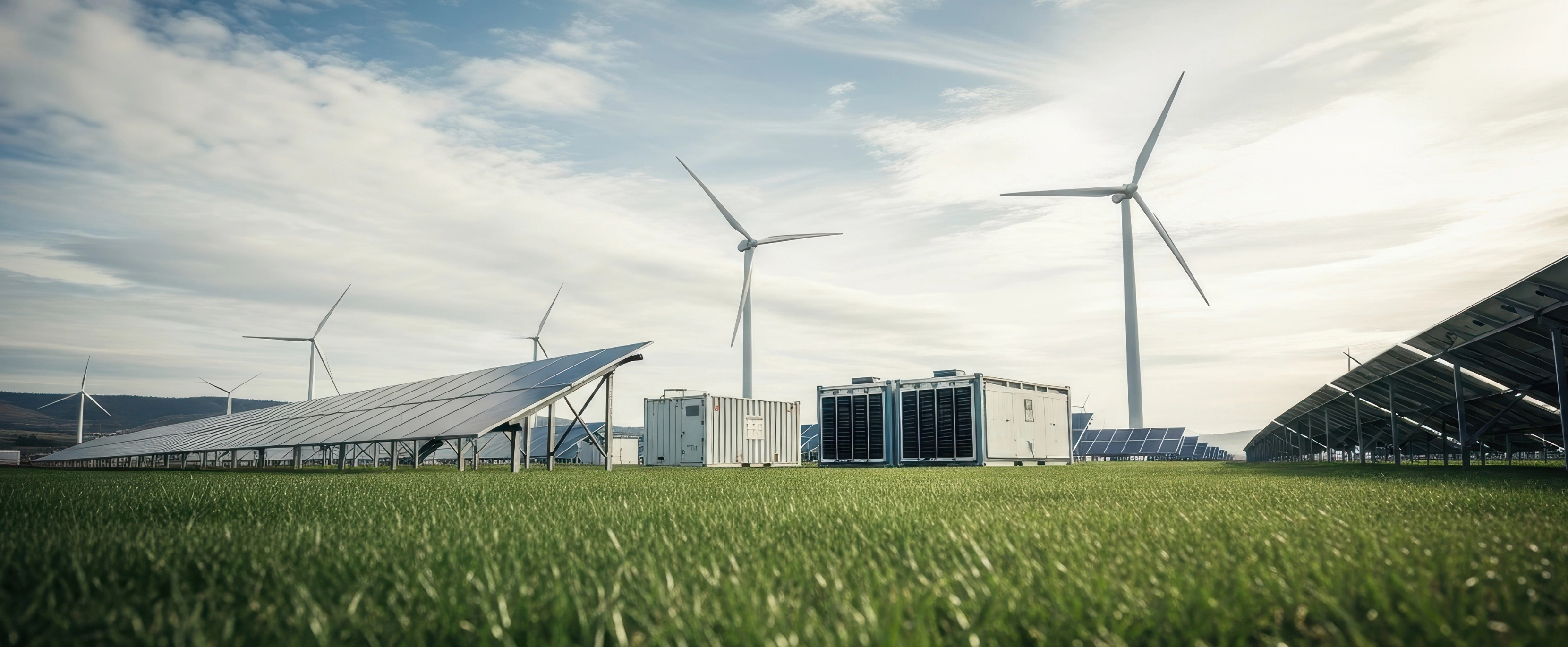
The Swiss electricity grid is already undergoing the biggest transformation in its history. Decarbonisation, decentralisation and digitalisation are changing everything: fossil fuels are declining, renewable energies are taking over, and heat pumps and electromobility are driving up electricity demand. At the same time, electricity is increasingly being generated decentrally, for example by solar and wind power plants, while digital technologies are ensuring more automation and efficiency – but also more demand (see data centres). Battery storage systems play an important role in this new energy system.
Like large power banks
Batteries can store electricity, especially when generation is high and demand is low. Conversely, they can supply energy exactly when it is needed – for example when there is not much sun and wind. For our society, this means greater grid stability and security of supply, even in periods of high demand.
Large battery storage systems are like large power banks for the grid: they can balance out fluctuations between generation and consumption, trade energy on the control energy market and contribute to voltage maintenance. They therefore make a decisive contribution to grid stability.
Our contribution to the transformation ...
But when does Swissgrid come into play? Storage plants with a capacity of 150 megawatts or more are generally connected directly to Swissgrid’s extra-high-voltage grid. Smaller systems are integrated into the distribution grids.
Swissgrid sees battery storage as a key technology for the energy transition. It not only facilitates the integration of renewable energies, but also increases the flexibility of the entire electricity system. Storage solutions will play a vital role in the energy system of the future. That is why we are committed to seamlessly integrating this technology into the transmission grid and creating the necessary conditions for its successful deployment.
... and we have already made a start
We have already taken the first concrete step and defined the technical minimum requirements for connecting large storage systems. Our aim is to promote innovation and work with partners to lay the foundations for a sustainable energy system. These minimum requirements are published on our website: Grid connection – Connecting a system to the transmission grid.
By publishing this information, we are establishing standardised, transparent requirements that apply to all large-scale battery projects. Swissgrid is thereby setting clear and binding guidelines.
Grid connection, a complex matter
However, connecting such large storage systems to the grid is complex and takes several years from planning and construction to commissioning. It all comes down to the technology: large batteries are a new and complex technology that must be integrated into an existing system without jeopardising its stability. Swissgrid’s transmission grid ultimately forms the backbone of a secure supply of electricity.
By way of comparison, imagine a city that needs to be connected to the motorway network. Simply building the city and a motorway link is not sufficient. A comprehensive traffic concept, access roads, traffic lights, signalling system and much more is needed to ensure that traffic runs smoothly – otherwise there is a risk of gridlock.
The situation is similar for large batteries and their connection to the transmission grid: studies, supporting documents, contracts, testing processes, IT systems and technical equipment such as transformers are required – and, depending on the situation, a new line may need to be built to connect the battery to a substation.

Lengthy processes and delivery times also play a role
There are other factors to consider when connecting batteries to the grid. The construction of the battery system and its grid connection line are subject to an approval process, which may result in objections. And as readers of this blog know, the approval processes for power lines and extra-high-voltage installations are very long. This is why it often takes a long time to obtain all the necessary approvals. For more details, visit the «Grid express» page.
The delivery times for components are another problem. Transformers for the extra-high-voltage level are in high demand – delivery can take several years.
So what can we expect in the future?
The transformation of the electricity system is underway and is bringing about rapid changes. Swissgrid is at the centre of this upheaval. In the light of the ongoing transformation of the electricity system and recent developments in neighbouring countries, an increase in the number of batteries and requests for grid connections should be expected. Swissgrid is promoting the development of this new technology, taking into account the challenges mentioned above.
This is Swissgrid’s approach: we are committed to seamlessly integrating new technologies into the electricity system. Our aim is to actively promote innovation and to work with our partners to create the basis for a future-proof, stable, secure and sustainable energy system.
Author